
Cover crops are planted in the off-season to help protect soil from water and wind erosion, and reduce nutrient runoff.
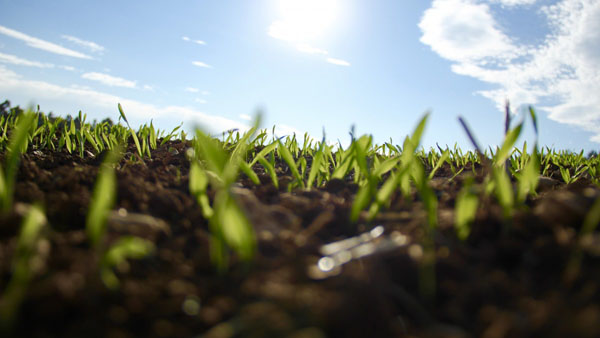
(Indianapolis, Ind.) - A farming practice that could make land more sustainable in the future appears to be growing in popularity in Indiana.
Cover crops are planted in the off-season to help protect soil from water and wind erosion, and reduce nutrient runoff.
The Environmental Working Group compared cover crop acreage in Indiana, Illinois and Iowa from 2015 to 2017, and found a net increase in all three states.
Indiana added 83,000 cover crop acres - a 10% increase.
Report author Soren Rundquist, director of spatial analysis at the Environmental Working Group, says it's a step in the right direction, but far from what is needed.
"We welcome this growth of this practice, intended to reduce agricultural runoff polluting surface waters," he states. "But the scale to which this practice needs to exist to make substantial change is still kind of a drop in the bucket, more or less."
The research found fewer than 8% of all corn and soybean acres in Indiana were protected by cover crops. And Rundquist says 4.7 million additional acres of cover crops are needed to protect just half of the corn and soybean acres in Indiana.
The Census of Agriculture ranked Indiana third among states for planted cover crops in 2017.
Illinois and Iowa added more cover crop acreage than Indiana, and Rundquist says there's a good reason.
"Indiana has a smaller universe of corn and soybeans on their landscape," he explains. "So, Indiana didn't gain as much, but they still have the highest percent of cover crops on their landscape, because they don't have as many corn and soybean acres as Illinois and Iowa."
For farmers, the use of cover crops has its challenges, including costs to implement the practice and the possibility of lost yields.
Rundquist says cost sharing and crop incentives can help offset those costs. He adds that farmers already using cover crops understand they're a long-term investment.
"The adoption of this practice is kind of contingent on farmers talking to each other, and more or less hearing it from other producers, seeing the gains and benefits of utilizing this practice on their own," he states.
Small grains and legumes are the most common cover crops used in Indiana. And state figures show that cover crops planted in the fall of 2017 prevented nearly 3 million pounds of nitrogen, 1.4 million pounds of phosphorus and roughly 1 million tons of sediment from entering Indiana's waterways.
 RCCF Announces 2027 Lilly Scholarship Finalists
 Operation "Rusty Cherub" Nets Multiple Arrests
 Honda Grant Supports Batesville High School Digital Design Pathway
 State Employees, Students, and Veterans Encouraged to Serve as Poll Workers on Election Day
 SRO Arranges Blackhawk Helicopter Visit at Area School
 East Central FFA to Compete at National FFA Convention














Comments
Add a comment